
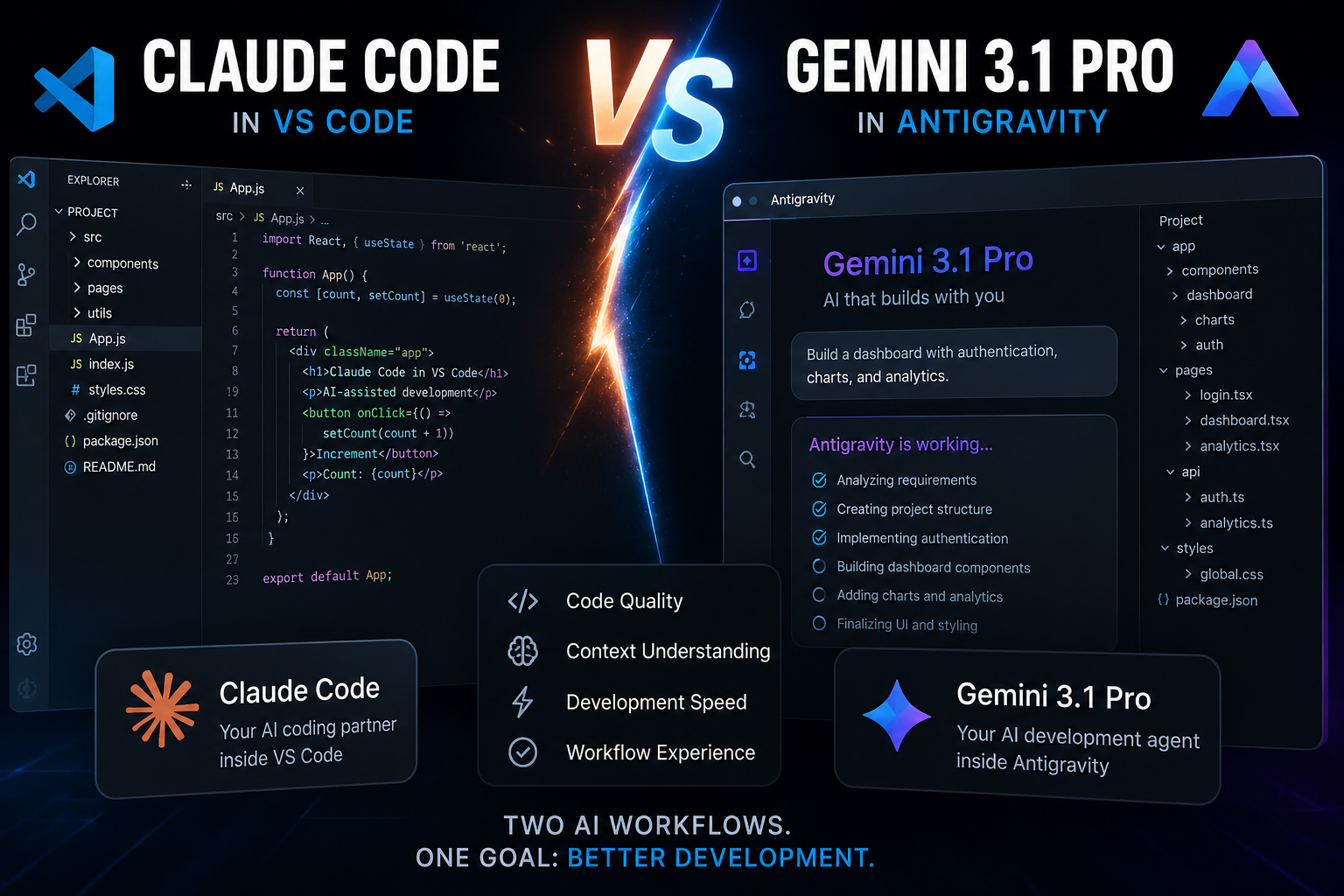
Artificial intelligence is no longer just helping developers — it is actively becoming part of the development process.
Today, two powerful approaches are emerging in AI-assisted software engineering:
Traditional AI coding inside developer tools
Fully agentic AI environments that control the workflow
In this comparison, I tested two systems in real development scenarios:
Claude Code inside entity["software","Visual Studio Code","code editor"]
Gemini 3.1 Pro inside Google Antigravity
This is not just a model comparison.
This is a workflow vs workflow experiment.
🧠 The Core Difference
Most people think AI coding tools are just “models”.
In reality, the environment changes everything.
Claude Code (VS Code Workflow)
Claude operates inside a traditional developer environment:
Developer writes or controls most steps
AI assists with reasoning, generation, and refactoring
Execution remains human-driven
Context is managed inside project files manually
This creates a controlled, predictable development flow.
Gemini 3.1 Pro (Antigravity Workflow)
Gemini inside Antigravity behaves differently:
AI operates as a more autonomous agent
It can manage multi-file context automatically
It attempts to handle broader tasks end-to-end
Less manual step control required from developer
This creates a semi-autonomous development flow.
⚙️ Real Testing Environment
To keep the comparison practical, both systems were tested on identical tasks:
Code generation tasks
Debugging scenarios
Multi-step feature building
Logic-based programming challenges
The goal was not just to see which writes code —
but which one actually supports real development better.
🔍 Observations: Claude Code (VS Code)
Using Claude inside VS Code showed strong performance in:
✔ Structured Thinking
Claude breaks problems into clear logical steps before generating code.
✔ Cleaner Code Output
Code is more readable and easier to maintain.
✔ Better Control
Developer stays in charge of architecture and implementation decisions.
⚠ Limitation
Requires more manual direction for larger multi-file automation tasks.
🔍 Observations: Gemini 3.1 Pro (Antigravity)
Gemini inside Antigravity showed a different behavior pattern:
✔ Fast Iteration
Very quick at generating full solutions and modifications.
✔ Strong Multi-Context Handling
Better at understanding broader project scope automatically.
✔ Agent-like Behavior
Can attempt end-to-end task execution without step-by-step prompting.
⚠ Limitation
Sometimes over-assumes structure or modifies more than intended.
⚖️ Key Insight (Most Important Part)
This comparison is NOT about “which AI is smarter”.
It is about how AI integrates into development workflows.
Claude Code → Developer-Controlled AI
Best for:
Backend systems
Architecture design
Clean, maintainable code
Precision-based development
Gemini 3.1 Pro (Antigravity) → AI-Controlled Workflow
Best for:
Rapid prototyping
Multi-file exploration
Experimental development
Fast iteration cycles
🚀 Real Conclusion
After testing both systems in real scenarios, one thing is clear:
The future of coding is not one AI replacing another — it is multiple workflows serving different developer styles.
Claude represents the precision engineer mindset.
Gemini represents the autonomous builder mindset.
The real power comes from knowing when to use which.